VTT, Chapter 1.
Added 2025-08-27 18:32:05 +0000 UTCPlease note that the synopsis and title is still tentative. I do hope to hear your thoughts on this !
Title: Villainess of Tangled Tragedies
Synopsis:
She always knew that Celestia von Reingarde was never meant to matter. In the pages of Tower of the End, Celestia was nothing more than a petty villainess, a spoiled noble girl with sharp eyes and crimson pupils, remembered only for bullying a shy healer until the “hero,” Arthur, arrived to play the gentleman. One scene, one humiliation, and she was discarded so the harem could bloom.
Except now, she was Celestia.
In her former life, she was a ruthless critic of webnovels: the heiress of a wealthy family, jaded by luxury, who hunted for tragedy in stories the way others hunted for romance. She hated happy endings, scorned shallow power-fantasies, and delighted in tearing them apart with merciless reviews. Until one late-night drive ended in shattered glass and silence. When she woke again, it was inside the very first webnovel she had mocked.
At first, she thought she could slip away. Why meddle with Arthur’s destined rise? Let him climb the tower, collect his lovers, and save the world. She would live quietly in the background. But the world disagreed.
A voice seared through her mind:
[Warning! Story Relevance: 3/100.]
[Warning! Existence will be erased when Story Relevance reaches 0/100.]
Now, obscurity meant death.
*****
The review window blinked.
“One out of ten. Too happy, too clean. Where’s the ruin? Where’s the misery? Stories without actual challenge aren’t stories at all.
This started well enough. With Jacob being weak, struggling to survive in a broken system, that had potential. But the moment he got the leveling ability, the tension collapsed. Every fight after that was predictable: grind, new skill, instant win. Watching him bulldoze through dungeons stopped being exciting after the third repeat.
The supporting cast may as well not exist. His guild ‘allies’ and family vanish into the background whenever the plot doesn’t need them. Relationships are teased but never developed. Everyone exists to admire Jacob, and it’s tiring.
The villains are no better. They seemingly enter with “threat,” only to be flattened within a chapter. There’s no lasting consequence and emotional weight. It’s all sparkles and fairytales without substance. It’s shallow comfort dressed as “struggle,” and that’s why it fails.”
She pressed submit without hesitation, lips quirking as the score registered.
—“Happy endings are the best. Don’t ruin it.”
—“What is this reviewer even talking about?”
—“Did you actually read the book?”
—“Why are you such a hater?”
Soon, the thread lit up. No doubt, angry fans defending their precious sugar-spun ending, insisting that happiness was what readers needed. She disagreed. Happiness was cheap; tragedy was real.
She wasn’t cruel, not really: she didn’t want suffering for its own sake. She had simply never tasted it herself, and so it fascinated her. The heartbreaks, the betrayals, the inevitable collapse of fragile dreams… these were the marks of lives lived honestly.
Watching characters stumble and break was the only time a story felt true.
Her own life was a straight path with no bumps. Born with a diamond spoon in her mouth, her parents’ names were behind every door before she even reached for the handle. Her university years were a mix of parties and luxury trips branded as “student retreats.” Even professors lowered their standards at the first glimpse of her surname on the roll.
After graduation, finding work wasn’t a struggle.
One of her parents’ companies brought her in, immediately placing her in a high-level management position that most people her age could only dream of. The job was really less about her impeccable skills and more about her family name, but she never questioned the arrangement.
Her days in the office were predictable: meetings began when she stepped through the door and ended the moment she closed her notebook.
“Rewrite this,” she would say, sliding a folder across her polished desk without opening it. “Make it perfect. I expect it this evening.”
She would even snap her fingers at her secretaries while walking past. “Coffee. Use that new brand from Cali. And put in a call to accounting; I want their quarterly numbers before lunch.”
Any mistake was corrected with two words: “Fix it.” She never bothered with explanations.
She handled romantic relationships pretty much the same way. She’d had boyfriends during university and after, but none lasted more than a year. They often described her as demanding, someone who needed attention and comfort without offering much in return.
She did not see it that way, but she noticed how quickly the men around her lost their patience.
Matchmaking for a good marriage came next, arranged through her parents’ social circles. They paired her with sons of executives, heirs of old families, and even a few politicians’ nephews, all presented as suitable partners. Each match began with promise, filled with polite dinners and family introductions, but they ended just as quickly.
She was too particular, and they were too ordinary.
Over time, she stopped expecting much from relationships. They had become another form of leisure, another way to fill the calendar rather than a step toward anything meaningful.
Yet, even with her job and her social life, she found herself facing something she had never expected: emptiness. Each and every milestone that others celebrated felt unremarkable to her. Promotions were meaningless when they were guaranteed, and relationships faded without leaving any memory worth keeping.
To distract herself, she searched for new hobbies.
For a while, she found herself drawn to gacha games, lured by the promise of rare rewards and colorful characters. She spent far too much money rolling for digital figures, the rush of chance filling her evenings.
It was exciting in the moment, but the thrill disappeared as quickly as it came. After all, all she needed to do was pour more money into it to solve the problem.
In that boredom, she found something else: webnovels.
At first, they were nothing more than another distraction, something to skim while lying in bed after work. But soon, she realized they offered more than she had expected. Unlike the polished books on bookstore shelves, webnovels had no filter. They came from anyone willing to write, whether or not they could, and within them, she found ideas far stranger and more human than what she was used to reading.
There were hidden gems buried under the endless lists of titles. She discovered obscure stories where authors dared to write about grief, betrayal, and ruin without softening the blow. These works struck her as more authentic than the carefully crafted happy endings she’d grown to dislike.
There, in those raw, unpolished chapters, she found something closer to the tragedy she had always wanted to see.
For a time, her hobby filled the void. She spent late nights following obscure series, leaving comments, and even joining communities where readers discussed their favorite works.
The unpredictability of webnovels gave her a sense of discovery, a feeling she rarely experienced in her own life.
But trends, as always, began to shift. More and more authors abandoned unique ideas in favor of what sold best. Romance-driven fantasies, shallow action stories, and formulaic plots increasingly filled the updates page.
Writers who had once dared experiment now wrote only what they thought would earn them views and income.
They disgusted her.
The very medium that had once offered her something real was being eroded by the same forces that shaped every other industry. Uniqueness was traded away for popularity, and her beloved tragedy was softened for what the public favored.
To her, it was all just another reminder that happiness was cheap, and the pursuit of it ruined everything.
Her frustration soon gave rise to a new habit: whenever a story fell into predictable patterns, she gave it the lowest rating she could, and left behind a sharp review. It wasn’t enough to simply drop the novel; she wanted the author to know why their work was unworthy. The more she read, the more mediocrity she recognized.
Each time she saw another cliche trotted out as though it were fresh, her patience thinned until her only outlet was criticism.
She lashed out often, leaving one-star reviews that cut straight to the point. To some readers, she was a menace, an anonymous figure who crushed rising stories with blunt dismissal. To the authors, she was worse.
Many reported her behavior, flooding the moderators with complaints and demanding her account be suspended.
But nothing came of it. After all, her parents owned the very platform where these writers published. She had complete and utter freedom to say whatever she pleased.
Even so, she didn’t abandon her respect for the act of writing itself. She never dropped a story partway through, not even the ones she despised. If she was going to rate it poorly, she made certain she read it to the final chapter. In her mind, only those who endured the entire work had the right to condemn it.
Sometimes her reviews stretched to paragraphs, line-by-line explanations of where the author had failed. She broke down tropes, listed cliches in order, and mocked cheap twists that had been done a thousand times before.
In the comments, she accused them of chasing easy dopamine hits, pandering to readers who wanted comfort instead of depth.
To her, their kind of writing was cowardice. It avoided the raw honesty of tragedy and replaced it with artificial highs that never lasted.
But her life changed one evening.
She left the office with her phone in hand, sliding into the driver’s seat of her imported sedan. The engine roared to life, and the car rolled forward.
Her phone dinged with a notification. She normally kept her phone on silent, so it was a curiosity as to why her phone made a sound. Her eyes were fixed on the screen as she tapped it open, revealing an email message.
—Congratulations, you’ve been chosen.
She barely noticed the vehicle speeding through the intersection from the side.
BANG!
The crash came with a violent crunch of metal, her body slamming against the airbags as glass shattered around her.
Pain tore through her chest and air fled her lungs. The phone flew out of her hand, its bright screen smashing against the floor.
She tasted blood, heard voices shouting outside, and felt the heat of something leaking in the air.
‘W-what happened?’ She tried to make sense of things, but her thoughts were in disarray.
She tried to lift her arm, but it refused to move.
Soon, she could hear screams and people shouting. “Hey! There’s a car accident here! Call an ambulance!”
‘Ah… I must look ugly bleeding out right now…’ Those were her last thoughts, before darkness swallowed her.
*****
The story she’d picked up that day had been a tower-climbing fantasy epic that was at the top of the site’s rankings.
Its premise was simple. A massive tower had appeared in the middle of the continent, its one hundred floors rising into the clouds. The world had changed upon its arrival, for the tower declared a trial: clear the tower within ten years, or the world would be destroyed.
Of course, the main character just happened to be the most generic man alive.
How generic? His name was Arthur.
Arthur was introduced to the story as a commoner born into hardship, but he conveniently possessed every hidden advantage possible. He was handsome but modest, strong but humble, and his destiny was spelled out from the very first chapter.
The tower itself was a carnival of clichés. Every floor represented a different trial: goblin caves, lava mountains, deserts, frozen wastelands. Each challenge was described as impossible, but Arthur always overcame them with either sudden bursts of strength or convenient items appearing at the last moment. Wherever there was a locked door, a key would fall into his lap. Wherever there was a deadly trap, his god-given instincts would miraculously flare for the first time, saving him.
Readers were expected to applaud each “narrow escape.”
Outside the tower, Arthur lived in the university city that had sprung up around its base. Ostensibly set in a world of medieval fantasy, the city looked suspiciously like every standard academy setting: professors lectured on ‘mana theory’ and survival tactics for climbing the tower; noble heirs strutted about like peacocks; and Arthur, still technically a poor commoner, somehow always ended up being the center of attention.
He gained a harem, of course. By the end of the fifth arc, no fewer than four women had attached themselves to him, including a fiery redheaded swordswoman, a shy healer with silver hair, a noble princess who saw “something special” in him, and an elven archer who inexplicably abandoned her sworn duties to join his climb.
Each one fell for Arthur without resistance, their personalities reduced to one-note traits meant to orbit his greatness.
The tower’s deadline hung over the world, but hardly mattered. Every arc promised impending disaster, then undercut itself the moment Arthur stumbled into another miracle.
By the halfway mark, the plot stopped pretending to be anything other than it was. Arthur was the chosen one, the only one who could save the world; the story bent over backwards to make him untouchable.
“What the fuck?!” She had finished the latest chapter with mounting disgust. She’d wanted to throw her phone out the window. It was the first time she felt compelled to not just drop a book, but to attack it outright.
Her review had been merciless.
She called the story a joke, Arthur a cardboard cutout with plot armor thicker than a layered brick wall, and the harem a fantasy written by someone who had never spoken to a real woman.
She highlighted every lucky break, every contrived twist, and every trope paraded as “originality.”
Readers had defended it, of course. Fans insisted Arthur was “inspiring” and the harem “romantic.” But to her, it was everything wrong with stories, merely junk food passed off as art.
Unfortunately for the wealthy heiress, upon the moment of her death, she’d found herself transmigrated into the very same story she so despised.
*****
The first morning had been chaos. She had woken beneath a canopy of silks, sweating from a fever, her limbs trembling, and the next moment, worried voices surrounded her bed.
Her parents had nearly torn the room apart in their panic, shouting for the doctor, saying that their daughter had woken up. The man had arrived promptly, examined her pulse, and checked her temperature before finally declaring it was nothing more than a passing illness.
Still, her parents had not calmed.
“My darling, are you certain you feel well enough to be up?” her mother asked now, hovering near her bed. “You gave us such a fright when you collapsed. I’ve already told the doctors to prepare more medicine, just in case.”
“She still looks pale,” her father agreed immediately, though his gaze softened the moment he looked at her. “Perhaps you should rest a little longer, hmm? No need to strain yourself.”
Her mother still feared, holding her hands. “We can have the doctor return tomorrow. I will not take any chances.”
They hovered like this constantly, careful as though she might crumble at the slightest touch. At first, worry hovered in her mind. What if the parents of this body realized their daughter had changed? What if her mannerisms slipped, if she said something out of place?
But her worries were unfounded; her new parents were doting to the point of blindness. They offered her gifts without being asked, hovered over her health, and reassured her at every turn.
Far from suspicion, they seemed eager to indulge her every whim.
Once she fully recovered after a few days, she had a clear idea of where she was now.
Lifting the porcelain cup to her lips and sipping carefully, she let the warm tea spread across her tongue. The manor’s drawing room was quiet except for the faint rustle of servants moving in the hall; she found the calm almost amusing.
Only a few days had passed since she’d opened her eyes in her new body, but already the household bent to her whims.
Within the manor’s library, she found records of the tower’s appearance five years ago. It seemed coincidental at first, but upon further reading, too many things lined up perfectly.
She was inside the novel she had once ridiculed: Tower of the End. That angered her, but was there really anything she could do about it?
“Make-up,” she said after she finished tea-time, her voice carrying across the room.
“Yes, My Lady,” her personal maid replied immediately, bowing her head before fetching the box of powders and brushes.
She sat into the cushioned chair before the large mirror in front of her, framed in carved silver, its surface clear enough to reflect every detail. She studied her face the way an artist would examine a canvas.
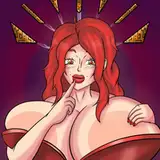
Platinum-blonde hair spilled down her back. Her chin was sharp, her lips pale, and she had sharp eyes that seemed to intimidate anyone she glared at. But most importantly, she saw her noble family’s most famous trait, enchanting red pupils.
She lifted her chin slightly, admiring the sculpted body and face in the mirror.
Her place in the story had become clear after a few days of careful recollection. In the Tower of the End, she was a minor villainess, a stepping stone to highlight Arthur’s so-called chivalry.
Her name in this body was Celestia von Reingarde. Generic, almost painfully so.
In the webnovel, Celestia’s role had been comically pitiful. She was remembered for petty cruelty; she bullied one of the female heroines, a shy commoner girl with a talent for healing magic. Arthur, ever the gentleman, intervened at the perfect moment, scolded Celestia in public, and gained the healer’s admiration. That single scene was the spark that set off their entire romance subplot.
Celestia, meanwhile, after a few more scenes to highlight the newfound connection between Arthur and the silver-haired healer, slowly faded into irrelevance. A villainess of convenience, used once and discarded.
Still having her make-up done now, she tapped one finger against the polished armrest. ‘If that’s the case, then I don’t really have to do anything, right?’ she thought to herself.
‘Let Arthur climb the damn tower and save the world. I’ll just stay out of the way, enroll at some other school, live quietly, and watch this circus from a distance.’
The idea soothed her. Why force herself into the mess of Arthur’s miracles and harems? The plot could move on without her interference.
She had no desire to stand in the spotlight if it meant being trampled by clichés.
But just as she leaned back, a sound like static crackled in her mind. A sharp, artificial voice blared as though spoken directly into her skull.
[Warning! Story Relevance: 3/100.]
[Warning! Existence will be erased when Story Relevance reaches 0/100.]
Her eyes widened. “What the f–”
Chapter 1: “1/10 Rating”
Comments
Update feel like I’ve seen ana anime of this once
Slamskull16
2025-08-27 20:30:47 +0000 UTCLooks good so far excited to see how it pans out I feel the same thing with the genericness of most web novels
Slamskull16
2025-08-27 20:29:21 +0000 UTC