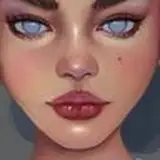
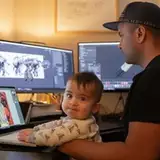
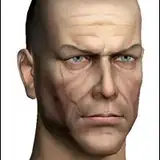
When beginning to work with the head in profile, it pays to memorize a basic pattern to avoid a disproportional design.
By pattern I mean an outline that provides a basic design framework to follow, varying to suit a subject's profile and feature placement.
I've illustrated a simple example. Note...
2016-05-23 02:40:52 +0000 UTC
View Post
Chiaroscuro (ki-aro-sku-ro) is an Italian word, chiaro meaning light, scuro meaning dark. It was a technique used to full effect by artists such as Leonardo da Vinci, Rembrandt and Caravaggio to name just a few.
Chiaroscuro is a technique used in the visual arts to produce interesting compositions of light a...
2016-05-21 20:01:24 +0000 UTC
View Post
Rembrandt lighting is commonly used in portrait photography and painting, cinema, animation and manga.
A triangle of light appears on the less illuminated side of the face, as form shadows generate compositionally interesting interactions of light and dark shapes. This is sometimes called chiaroscuro, a term which usua...
2016-05-21 01:17:25 +0000 UTC
View Post
As an exercise, painting the head with a variety of lighting setups can help us understand the complex planes of the head and face. Learning the shadow shapes as they fall across different kinds of faces with different bone structures will teach us the commonalities.
Try taking several reference photographs of a ...
2016-05-19 22:26:58 +0000 UTC
View Post
The occipitofrontalis muscle runs from the front of the skull (the frontalis, as illustrated) across the scalp as a tendon, to the back of the skull (the occipitalis).
The muscle is for expression only, raising the eyebrow from two areas, the medial fibers pull the outer corners of the eyebrows and the lateral fibers w...
2016-05-17 23:40:45 +0000 UTC
View Post
Depth of field is a term to describe the range of acceptable sharpness within an image.
Often used in photography to make areas pop by contrasting sharpness with blurriness, depth of field is an effect we can achieve in our work to the same end.
When planning an image, try separating areas i...
2016-05-16 07:55:06 +0000 UTC
View Post
Angles offer the storyteller an effective way to relate the audience to a scene and/or character. The audience's judgment of characters can be guided and influenced when using angles to enhance story.
The basic principles are:
- If we're looking down at a character, they appe...
2016-05-15 08:01:25 +0000 UTC
View Post
If you ever do sequential art like comics or storyboards, or if you're planning an animation or a film, then some cinematography basics will come in handy.
The right framing will serve the story visually, captivating your audience. The wrong framing will bore or confuse your audience.
I've presented ...
2016-05-14 09:31:45 +0000 UTC
View Post
When creating a caricature of a subject we have the opportunity to include an action or have the character placed in a situation.
This should add to the comical feel of the image overall, and breathe a little more life into the portrait.
Referring to my example image, I was lucky enough to snap a photograph o...
2016-05-13 17:26:38 +0000 UTC
View Post
There's a tough balancing act at play in the creation of a character portrait, or caricature.
The trick is choosing which features to exaggerate. For example, it might seem that exaggerating the size of the nose is the right thing to do only to realize that actually it's the eyes that need to be smaller and by ...
2016-05-12 18:44:16 +0000 UTC
View Post
This is a general break down of the proportions of a young babies head (1 yr old). Of course, there are many different shapes and sizes, and arrangement of features, but there a few things we can keep in mind.
Height Spacing
- From the side, the head fits fairly well into a perfect ...
2016-05-12 05:13:13 +0000 UTC
View Post
The grid method is not only a really effective and accurate way to transfer an image into a drawing or painting but it's also perfect for getting into your subject in preparation for a greater artwork, if you choose.
I'll talk about using the grid method for creating accurate portraits a little after this next p...
2016-05-11 04:36:43 +0000 UTC
View Post
Drawing curves without the aid of tools like the french curve or compass can be one of the most frustrating things for a learner or even for a seasoned pro. I bet even Leonardo Da Vinci struggled!
It's important to understand that drawing curves (or straight lines for that matter) won't be easy if you haven't been...
2016-05-09 09:11:16 +0000 UTC
View Post
You might notice your fingers turning pink in the cold, or your nose, just before an awkward sniffle. This is blood rushing to your extremities to keep you from getting too cold. It's most noticeable on fair skin, but can be seen on all skin types. Other places we might see this color change are cheeks, ears, elbows, knees, toes...
2016-05-08 17:29:45 +0000 UTC
View Post
Texture is going to be visible depending on the depth of the textured surface and the lighting setup in a scene.
If the lighting is mostly ambient or soft then we'll see a fairly well defined texture throughout. However, things get a little different in hard light situations.
Angled, single light so...
2016-05-07 20:31:32 +0000 UTC
View Post
Ambient occlusion is a painting or rendering technique which adds realism to an image.
As light is hitting a variety of surfaces, all points that aren't absolutely hidden from light are illuminated to some level.
Any surface that is angled towards another surface will reduce the amount of light those area...
2016-05-07 03:42:02 +0000 UTC
View Post
Here's a quick tip to help your subjects stand out from their backgrounds.
Used often in cinema and photography, reversing the gradient of the background will give greater contrast without pushing the values.
When used to the extreme, the effect is more dramatic, adding a mysterious or moody ele...
2016-05-05 15:48:50 +0000 UTC
View Post
Here's a quick process often used in observational drawing.
Learning to simplify the shadow shapes and other forms is a great exercise which will transfer skills to other areas of your work.
Give this one a try next time you are out sketching and there's a strong light source.
The more you p...
2016-05-05 04:58:36 +0000 UTC
View Post
To go a bit further on spatial depth, I've illustrated how objects are most effectively placed spatially using occlusion, or overlap.
Occlusion trumps all other depth cues including perspective, size and color, etc.
If we want to be really certain about which objects in a still life or which parts of the figure...
2016-05-03 07:04:12 +0000 UTC
View Post
We can simplify complex forms and body parts into simple boxes and tubes
Though quick and effective, construction techniques are best employed after a we have gained a good understanding of the various plain changes and landmarks along the form surfaces.
We'll delve into this in upcoming tutorials, but for now,...
2016-05-02 07:04:57 +0000 UTC
View Post
When we wish to create a composition to lead the eye around an image, then we can use the gestalt principle of continuity.
The eye will follow paths that are clearly connected until the line of continuity ends or hits an object.
A path can run through an object if the object displaces to make wa...
2016-05-01 06:51:15 +0000 UTC
View Post
The figure / ground principle describes how we tend to separate elements (figures) from their environment (ground). It's impossible to have a figure element change its outline (silhouette) without also changing the shape of the ground.
Figure and ground can be illustrated simply as a dot on a page, the dot is overlap...
2016-04-29 23:53:01 +0000 UTC
View Post
Closure is perhaps the most important gestalt principle for the sketch artist wishing to use economical marks to convey information, playing on the viewers own inventiveness driven by the memory of familiar forms. We are simply connecting the dots when we see closure in action.
Impressionists use this ...
2016-04-27 07:07:22 +0000 UTC
View Post
By now we should have developed a sense of what we mean when we talk about key as it applies to visual art.
Here are some examples that explore a few ways we can vary the minor key to make adjustments in our image using color and scale.
Note: when the minor key begins to overwhelm the major key then that...
2016-04-27 02:21:21 +0000 UTC
View Post
Here are some color arrangements to demonstrate a measured application of major and minor keys.
The major key is the dominant, majority color in an image. It sets the general tone or mood and might be able to trigger a subtle emotional response from the viewer.
...
2016-04-26 09:09:35 +0000 UTC
View Post
The last tutorial (112) explained how high, mid and low value ranges can be applied to give us some options for mood and story.
This tutorial goes a bit further. We can play with accents to add a bit or interest.
High Key Major:
In general, the key is high range, except we are choosing to add low...
2016-04-24 15:34:45 +0000 UTC
View Post
Here's a visual example of how to make value arrangements based on the concept of delegating key value ranges.
You might notice that the key of an image can effect the mood or story quite effectively.
High Key:
Can also be called high key minor (we'll look at minor and major in the next tutori...
2016-04-24 09:19:47 +0000 UTC
View Post
Hey homies!
Just in case any of you guys live in LA and are around the Pasadena area later there's a show over at the Pop Secret Gallery in Eagle Rock, about 10 mins away from Pasadena.
Featuring incredible works from all these awesome artists. Maddie has even made a life sized sword! ...Sick!!
I...
2016-04-23 15:48:58 +0000 UTC
View Post
This image plays with the gestalt design principle of proximity.
Whenever we place things near each other in a painting or drawing, the viewer will usually assume those things belong to a group or are somehow related. We will either conclude they share a similar attribute or we might search for a relationship,...
2016-04-22 13:01:04 +0000 UTC
View Post
Here's a simple graphic illustration of a scene from Game of Thrones when Jon Snow battles a white walker. I've tried to use the gestalt principle of similarity to make a distinction between the white walker and the rest of the image as a whole.
It's true that when we perceive a group of objects we will naturally...
2016-04-21 14:09:40 +0000 UTC
View Post