Master's Journey: Tales to Astound! #1
Added 2018-12-29 20:22:21 +0000 UTCAuthor's Note: All-new Master's Journey, replacing Unlikely Dovahkiin either temporarily or permanently, depending on how well it's received. Starting with something vaguely Hyborian, but we'll see how it progresses with time!
[story]
_______________________________
Your lips part. Your chest heaves, a desperate attempt to wrench in air, to fill your lungs.
You find only sand.
Your gasp becomes a dusty, spluttering cough, which is quickly followed by a spasm of choking and hacking, your body contorting itself in a primal insinct to stay alive. Sand mixes with what little saliva you have, creating a thick, salty slurry that you somehow manage to cough up, pooling into the ocean of sand beneath you.
Only then do you finally take in a deep breath of air. More coughing follows, but you feel your lungs fill with wet, briney air, feel your chest swell out with it. Blood rushes to your head, agonizing at first, but your senses seem to be returning to you, one by one.
First comes touch. The sensation of sand against your bare knees and outstretched fingers, of your sticky drool streaming down your chin. You can feel the blazing heat of two suns beating down on your back, searing your already-scorched skin. You can feel hunger, and you can feel pain.
Next, your vision returns, though it remains blurry. A sea of coarse sand, as black as onyx, stretches out in front of you as far as you can see, but to your left side you catch a glimpse of green. You tilt your head, still panting heavily, spitting the charry granules out from between your teeth and beneath your tongue. Yes -- trees. Tropical trees, at that, high and relaxed, their wide, lazy fronds swaying in the ocean breeze.
As the pounding in your head slows, your hearing comes back to you, and you turn to your right follow the sound of crashing waves -- to stare into an infinity of rolling blue. The ocean, lapping hungrily across the black beach you find yourself washed upon. Chunks of wood, sails, and shattered crates seem to have washed up along with you, and through the salty air you catch the scent of decay. More bodies, washed up on the shore. None moving.
Were you the only one to survive...?
Struggling to your feet, you squeeze your eyes shut and feel them sting with the ocean brine they’d been so recently rinsed in. As your vision begins to grow clearer, you gaze up into a clear blue sky to stare up at the two suns -- the first and larger of the two is deep, dark blue in color, tinged with green. It moves slower than its sister, you remember that. The other is smaller, a piercing, vibrant pink, and it races across the sky, evading its brother each day to dance into the night, to cavort among three moons. They have names, and you can almost remember them, if you try.
Oyeph, that was the brother, the Lord in Blue. The pink one is Akkesa, the Dancing Princess. You know them, sailed by them. Or... did you? Perhaps you only heard of them, listened to the stories. It is hard to recall where you had been sailing, or why. Where you had been before. Where you were now.
Hot sand burns the bottoms of your feet as you move closer to the ocean, weaving your way through crates and corpses, looking for anything that might be of use to you. What clothing you might steal looks either ill-fitting, thoroughly bloodied, or destroyed beyond use -- many of the sailors and passengers appear to be impaled on broken spikes of wood from the ruined vessel, or simply drowned. Others, though, seem to have been killed in other ways.
You move past a man in dignified dress, his long coat, shirt of chainmail, and waterlogged turban marking him as the man who had been captain. His authority, it seemed, had not saved him, as a handle of the ship’s wheel was now embedded in his neck. You reach down to his belt and withdraw his sword, a tulwar of adequate make, though likely more decorative than battle-ready. Beyond him is the shattered core of the main mast, broken at the base and used -- seemingly with great purpose and intent -- to impale and stack the bodies of the ship’s crew. Their equipment would not be of use to you, either. Six of them, arranged back-to-belly, form a vile trophy, something to be left rather than taken. A sign, perhaps for the gods, or for whatever unfortunate salvagers might find the vessel’s wreck.
If only you recall what happened here, what men or beasts had tumbled down from the sky like drops of rain to insist upon so much carnage. All you can remember is the storm. Not your name, not your face, not your home. Only the sounds of thunder and screaming. Only the storm.
Staggering a few more steps, you gaze into the ocean, the light of the two suns dancing and rippling across it in complementing waves of vibrant color. In those endless blue depths, you see a face. Your face.
1) You are phyragian, one of the pale-skinned, crimson-haired barbarians from the far west, typically tall and robust. Known for their expansionist and warlike culture, the phyrai people are more likely to embrace and absorb new societies than cling to old traditions.
2) You are one of the kaltish people, black-haired and olive-skinned. Inherently lean and of medium height, your people built an empire in exploration and art, becoming financial and cultural powerhouses among the rest of the world.
3) You are one of the dark-skinned dhuvian people, tall and slim, known for their strict adherence to religion and tradition. This cultural fanaticism has given the dhuvians a well-trained and ferocious army, allowing them to guard their religious and technological secrets from within their empire of bronze.
4) You are one of the slightly-built, yet well-connected anami people, their skin light and their hair ranging from bright yellow to deep brown. Preferring to govern with diplomacy and neutrality, the anami are quick to befriend and slow to upset other cultures, smoothly integrating with other peoples and even lands to sow trade and foster alliances.
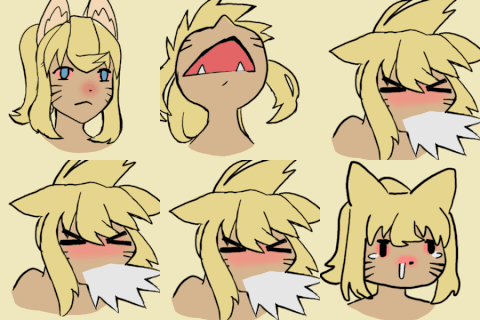
5) Often thought of as bestial or unnatural by the human races, you are one of the cassari, or “underfolk” in their own makeshift tongue. Often sporting pointed ears, tails, or forked tongues, non-human characteristics seem to be individual to every cassari. Born to human parents, and bearing certain traits of their race, little is understood about the cassari, who are treated with superstition and unease under the best of conditions. Dhuvian cassari are killed at birth.
a) you are male
b) you are female (presence or absence of dicc to be determined later)