
The Gliesa Project – First Biome
Added 2021-02-11 03:38:32 +0000 UTCHello everyone,
These past two weeks I’ve been upgrading the tools I need to design Gliesa’s terrain. The tools I’ve been using so far were great for creating normal Minecraft terrain, but for writing Gliesa’s complex terrain I had to rework the “terrain math” part of the SDK. The new tools are finally done, and I’ve officially started designing Gliesa’s first biome.
I can’t overstate how excited I am. In this article I want to go over this first biome by showing some prototype previews and going more in-depth than last time. Then I want to touch on the region buffering system and what it means for your server. Let’s get into it!
Gliesa's First Biome
If you haven’t already, I suggest you first read this article here about Gliesa’s world in general. In short, Gliesa is an alien world, a fantasy super-earth.
This first biome will have moderate temperature and moderate humidity (similar to Minecraft’s Forest biome). The fauna in sun-lit areas will be based around oak-like trees with a heavy number of custom trees, vegetation and alien life. Dark areas will have their own fauna depending on the location (depth, proximity to water, etc.). I will go in depth about the fauna and wildlife in another post as this one focuses on the terrain aspect.
As described in the article presenting Gliesa, this first biome is based on a mega-biome called The Stack. Every biome inside a mega-biome is based on the same terrain architecture. This allows biome transitions to be smooth and manageable for me, which is a big job when working with terrain as complex as this. The Stack’s terrain structure is based on 4 vertically stacked ground platforms. The platforms are connected with rock formations that support the ones above.
Below are some picture of the prototype I am working on. Please note that this is very early development, and there is a lot of work planned, some of which I discuss below the pictures. I want to bring focus to the general structure and not the details.
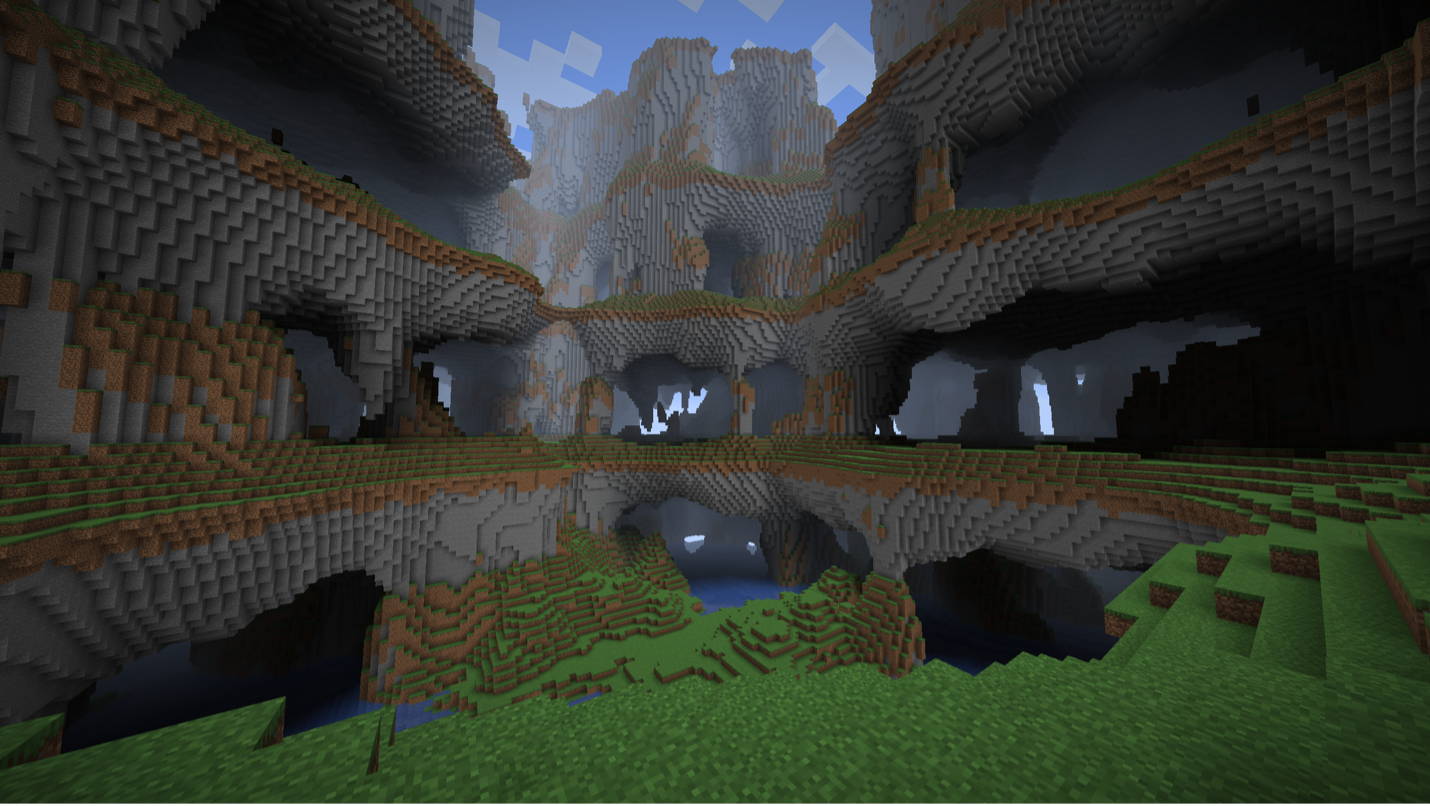
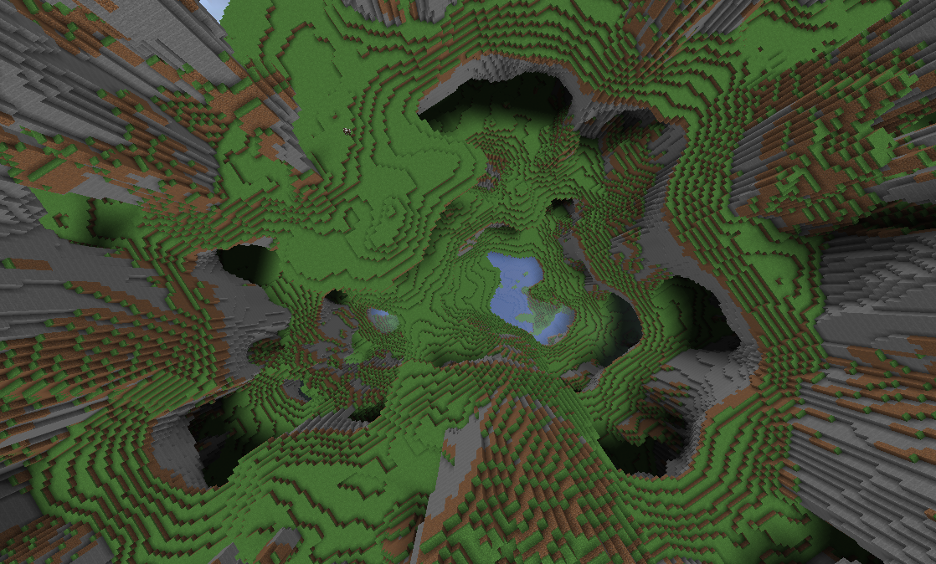
The pictures provide an early glimpse at the general structure of the biome’s terrain, a pre-alpha preview. These coming weeks I will be sculpting numerous aspects of this terrain.
In the pictures, each layer has the same exact internal rock formation that I used to test and debug. I want each layer to have its own rocky structure that makes sense for its placement and conditions.
The water layer (bottom one in the picture) will be composed of thick water tunnels populated by beautiful stalactites, stalagmites and other mineral formations. This is a moldy and wet environment that is buried deep underground. Sunrays occasionally peek through revealing its blue beauty to the layers above and bringing a fresh and cool breeze from below. The colors will be gray, white and black. The fauna will be themed around water, so you can expect spores, algae, moss, and Gliesa species.
The layer above the water one is drier, but still hidden away from the sunlight. This layer will have thicker rock columns connecting the floor and ceiling with occasional rocky areas creating walls and regions filled with rock. The floor material of that layer will be mud that has never seen the day and that has been moist for millions of years. Some plants here will connect the floor to the ceiling, other ones will only grow on the ceiling and walls, creating a web-like structure for the player to traverse.
The space right under the top floor will be a somewhat cold environment, a mixture of caverns and plant species that leaked in from the layer above. Roots from trees above sometimes pierce through the ceiling of that layer and break up the space. The materials here are different types of stone and dirt with some grass where sunlight reaches.
The top level will be the layer that looks the most “normal” with hills, cliffs, forests and plains. Streams will flow from the top of cliffs all the way to the edge of this layer, where they will turn into waterfalls, and continue down the layers below. The materials dominating this level are grass and coarse dirt. The fauna will be composed of oak and birch trees, occasional old mega trees, dead trees, bushes and plants, and numerous decorations making every corner unique and appealing.
Islands will hover above the top layer’s fields and forests, sometimes hovering above the large holes that cut through the layers. The islands will be generated individually as opposed to how floating islands are done in most other terrain generators (such as Minecraft’s The End, The Aether, etc.). This will give me a lot of control over their look and feel. My aim is to generate the most beautiful floating islands you’ve ever seen! I can’t wait to go more in depth about those.
When looking down from the edge of the top layer I want the explorer to feel overwhelmed with the depth and complexity of the terrain. I want them to understand how large this world is, and how much there is to explore. Lush vines connect opposing sides of different layers. Fauna from the layers above flows down the edges into the ones below. An ancient rune can be seen carved into a cliff wall 50 blocks below, with moss growing all around it. A waterfall streaming from layer to layer connecting them all together.
Right under the bottom water layer will be an upgraded version of the DWG cave system (from my cave update here). Because the lowest level is somewhat similar to the underground lakes from DWG, I will likely swap the DWG lake caves with something else.
In the previews above the layers all have the same height, and that height doesn’t vary at all. This won’t be the case with this biome, different layers will have their own heights, and the height will vary with location. This is important to the variety and the natural look of the landscape.
Each one of Gliesa’s biomes will come with lore and history. The geological formations and fauna will be documented and explained. When I introduce ruins and builds the lore will be expanded to include those as well.
This biome doesn’t have a name yet. I will post a poll on Patreon asking for name suggestions and then we’ll vote on it. This is a huge project, and this world will be extremely complex and compactly populated with content. Every chunk is packed with many times the complexity of a normal world. Your support is what makes this all possible. I can’t wait to discuss with you all ideas and the feedback you will provide on this.
Region Buffering System
This world generator is based on my terrain SDK, which generates large regions (20x20 chunks for example) at once. Spigot on the other hand requests chunks from basically random coordinates in the world. These two systems are not compatible because Spigot will constantly request chunks outside the region that has just been generated, wasting a lot of performance and freezing the server.
To address this problem, I wrote a file-based caching system that saves regions that have been generated temporarily until the server needs chunks from them. What this means for your servers is that you’ll need to make sure you have 500mb of disk space available inside your plugins folder. Also, this means that the speed of your server’s storage will affect generation time. Even with all the optimizations and the multicore support, Gliesa’s complex terrain is taxing on the CPU. I recommend pre-generating the world before using it on public servers with more than 10 players online to avoid occasional freezes when new regions generate. I will provide a pre-generation tool with the plugin to make this all easy. RayzarVeldar on Discord suggested that I generate the regions predictively as the player moves to ensure the world loads smoothly when players explore. This would allow using Gliesa live. I will explore that once we have enough content out for you to use.
Thank you all for reading, this is the beginning of something huge!